Hotels and Malls Near Jewar Won’t All Compete for the Same Customer — Here’s Why That Matters
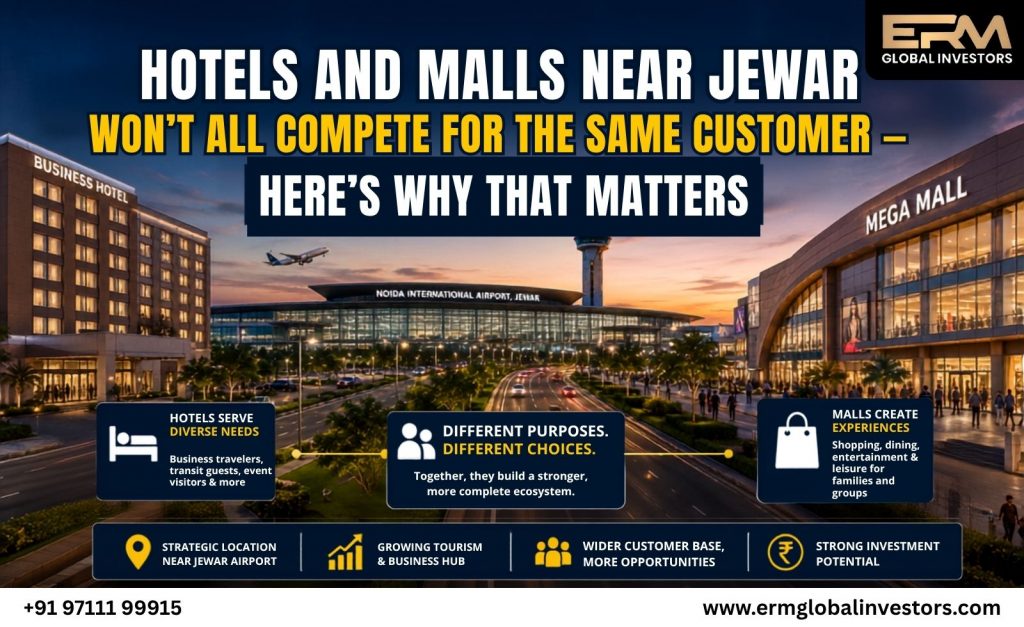
In most of the media coverage about Noida International Airport’s commercial plots possibilities, “hospitality demand” is treated as just one group. In reality, there are actually at least three distinct groups of people who can use the airport in question, and within just one week since the airport started functioning, signs have appeared that show this fact — and it will matter when hotel and retail developers plan their strategies.
Two Launches, Two Very Different Crowds
The first commercial passenger flight in Noida International Airport was operated by IndiGo and landed on June 15, 2026. Just two days later, on June 17, 2026, the first cargo flight to the airport landed, bringing domestic e-commerce freight from Chennai via Afcom Cargo. Passenger flights became the news of the day. However, when hotel and retail developers assess their opportunities at the airport, they would probably care more about the cargo flight than about passenger flights.
These operations do not result in similar footfall. One brings transit passengers, tourists, and finally, connecting passengers via inter-national flights – just IndiGo’s first set of destinations serves 16 Indian cities already and Phase 1 is designed for some 12 million passengers per year with the eventual capacity for up to 70 million upon completion of further phases. Another result is employees: warehouse workers, customs clearance personnel, cargo brokers, and drivers who require quick food, budget accommodations, and convenience retail next to the cargo area rather than banquet rooms and five-star facilities.
The Cargo Hub Is Bigger Than the Headlines Suggest
The proposed AISATS multi-modal cargo hub comprises Phase One of 87 acres, consisting of a 30-acre processing terminal for export-import and customs activities, and 57 acres of logistics area for storage and multimodal transshipment, even temperature-sensitive. The initial annual throughput is 200,000 metric tonnes with stated expansion plans up to 1.5 million metric tonnes in future phases.
It is a substantial semi-permanent workforce footprint located right on the edge of the airport border – and it is a workforce which does not return to five-star facilities after work. Instead, it will be coming back to fast food courts, budget-to-mid-range chain hotels, and convenience retailing 24/7 because this type of activity does not operate from 9-to-5 hours. Any retail property located exclusively on “airport footfall” without taking this element into account is targeting the wrong customer base.
A Third, Completely Different Demand Profile: MICE
Factor in a third indicator which does not relate to either the airline passenger or the cargo industry: the close proximity of the airport to the India Expo Centre & Mart and the Yashobhoomi, India International Convention and Expo Centre. Already the importance of this positioning is being highlighted in the industry trade press as a real asset to the international MICE (Meetings, Incentives, Conferences, Exhibitions) market.
The MICE market requires something different from both the cargo employees and the vacationing traveler: large meeting space, quality food preparation facilities, and hotel capacity to absorb delegates during the concentrated time period of an exhibition.
Why This Matters More Than the Usual “Airport-Led Growth” Framing
Take the three all together, and rather than being geared towards the construction of one hospitality sector, the corridor is geared towards the construction of three layers, stacked on each other within the same few square kilometers, including a logistics worker budget sector in proximity to the cargo sector, a convention sector in proximity to the terminal and exhibition corridor, and ultimately a leisure/transit sector as the airport develops from its current 12 million passengers’ Phase I capacity to 70 million in the future.
This is much more important in allocating land than the commonly used airport city “more flights = more hotels” approach since the budget logistics worker hotel that is constructed in plots meant for the construction of convention business will underperform.
Real estate advisor , which monitors the trends in land usage within YEIDA’s commercial plots and hospitality developments, has identified the potential misallocation of such segments as a significant risk that remains largely overlooked in early stage development of airport corridors; developers usually apply a generic concept of “airport hotel” instead of trying to determine which of the three types of demand a particular plot is closer to.
The Honest Caveat
None of the above is definite yet. The first 200,000-tonne cargo throughput is just a small portion of what mature freight airports operate, international flights are still in the early stages of growth after the initial domestic-focused roll out, and MICE industry requires years of repeat business before becoming a regular occupier of the area, not a seasonal peak. The commercial viability of the corridor is there, but the more important question for anybody considering acquisition of a plot at the moment is whether it is airport-driven.