Natural Dye Bedsheet: What It Is and Why It Makes a Better Choice for Your Home
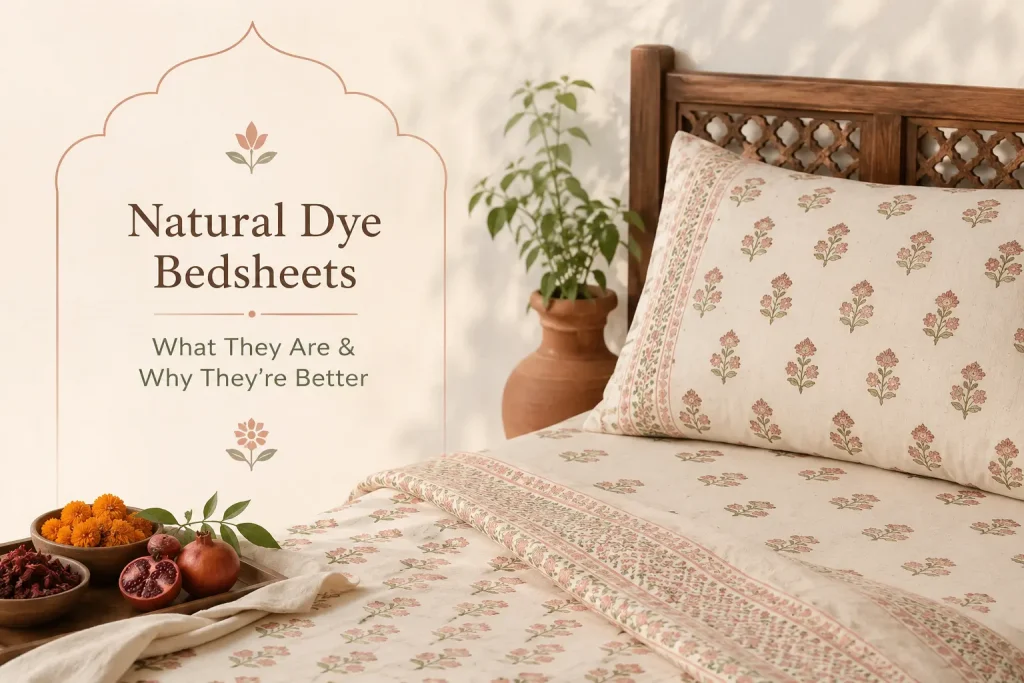
At the end of a long day, there is something comforting about slothing about your bed and slipping into your fresh, soft bedsheet feeling comforted by its warmth. We all choose our bed sheets carefully, analysing the print, the fabric quality or the thread count, but do we ever think about the dyes used to print those beautiful patterns? Probably not! The bedsheet fabric is the one our skin touches more than anything. And many homeowners are moving towards natural dye bedsheets as they are becoming aware of the harmful effects synthetic dyes can have on our health.
Making a conscious and more sustainable choice is becoming popular among homeowners, who are now ditching the mass-produced products.
What are Natural Dyes?
Natural dyes are colouring agents crafted using substances from nature. Colour has always been naturally present in nature. So natural dyes derived from plants, roots, barks, berries, fruits and even minerals have a rich history and long tradition of being used in the Indian subcontinent.
The block printing from Rajasthan, the resist dyeing from Gujarat, and the kalamkari art from Andhra Pradesh are just some examples of these crafts that developed in parallel with the use of natural dyes and their native plants.
From the colour indigo derived from the indigofera plant, to red taken from the root of madder (Manjistha), to yellow taken from turmeric or pomegranate rind, and shades of green and brown taken from different kinds of bark – is how our ancestors dyed cloth.
So the colours weren’t just beautiful, they were functional, safe, and sustainable by design. Many consumers today are returning to these age-old methods as they are skin and eco-friendly.
Why Synthetic Dyes are a Problem?
Most conventional and mass-produced bedsheets use synthetic dyes. The bedsheets go through a bleaching process in order to produce bright vibrant colors that do not fade over time.
Synthetic Dyes, particularly azo dyes, are the most commonly used chemical dyes in the textile industry. They are used for their vibrant colours, affordability and the fact that they are easy to apply at scale. However these dyes have unsafe chemicals that have-
- Environmental impact- Being a hazard to water bodies and aquatic life.
- Health Risks- Azo dyes break down over time and release aromatic amines, some of which are classified as carcinogenic (cancer causing chemicals)
Apart from the dyes used, the traditional process of dyeing textiles involves a wide range of chemical fixatives and softeners that give them the desired look and feel. All these chemicals remain inside the fabric, and every time you rest your body on it, your skin comes into contact with them. This can be the reason for skin irritation among people with sensitive skin.
Hence, the reason why many consumers now use dyes that are azo-free and natural dye bedhseets.
How are Natural Dye Bedsheets different?
Your bedsheet touches your skin for several hours every day. This means that the materials and dyes of your bed linens matter more than you think.
Natural dye bedsheets are safer, long-lasting and kinder to your skin. An organic bedsheet is free of harsh chemicals, softeners and azo-compounds. There are many benefits of a natural dye bedsheet like the ones discussed below.
- They are biodegradable and environmentally friendly.
- These dyes are also hypo-allergenic, meaning they are skin-friendly.
- They age gracefully, and mellow over time. The colours soften instead of just fading away.
- Better suited for children and older adults.
The list of advantages that one receives from plant based dye is much wider since they have special properties that cannot be mimicked by artificial dyes. The tones of colors are softer and deeper since they come from nature. Besides, each batch dyed by hand carries a special uniqueness and has slight variations. One might not get a perfectly uniform machine produced colour, but something that was made with care.
Azo-free Dyes
Azo free dye fabrics are Synthetic dyes that are provided as an alternative for chemical dyes in the textile industry. They are different from chemical dyes in the sense that they do not contain any harmful fixatives or compounds that release carcinogens (cancer-causing substances).
Aim to fill in the gaps of natural dyes. They are vibrant and produce a wider range of colours compared to natural dyes. Other advantages include-
- They are skin-friendly
- They also have a low environmental impact compared to azo-dyes
- Their vibrancy promotes sustainable fashion
Natural Dyes and Organic Bedding: What’s the Difference?
It is often presumed that when we talk about natural dye it automatically means “organic fabric” or the fabric used to make the bedsheet. However, the two are very distinct from each other.
An organic fabric bed sheet refers to the type of cloth or material used to make the bed sheet; For example- cotton, mulmul, linen or bamboo.
Whereas, a natural dye bed sheet refers to the organic dyes used to colour and produce a printing pattern on the bedsheet.
One tells you how the fibre was grown, while the other tells you how the fabric was coloured. If you are looking for the most mindful option, look for bed sheets that are a blend of both.
A Smarter Choice for your Home
Considering India’s Hot and humid climate, synthetically dyed bedsheets might cause skin irritation and make you feel hotter due to its roughness. Organic bed sheets that use natural and sustainable dyes prove to be gentle for your skin and have a breathable fabric.
It is easy to grab a bedsheet option that might seem cheap and affordable or attractive at first glance. However the choice should be considerably made. You might not notice the difference today, but your skin will notice it in the long run.
Natural dye bedsheets ask you to think differently. So the next time you give your bedroom a makeover, try to look beyond just the fabric and patterns.
FAQ’s
1. What are natural dyes?
Natural Dyes are dyes made from organic substances present in nature, such as- plants, roots, barks, berries, fruits and even minerals. They are free of chemicals and environment-friendly.
2. Are organic fabric bedsheet the same as natural dye bedsheet?
No, they are not. Organic fabric refers to the material ( such as cloth, linen, mulmul or bamboo) ; whereas natural dyes refer to the organic dyes used to colour the fabric.
3. Is a natural colour fabric bedsheet better for the skin?
Yes, natural dyes are better for the skin as they are made from plant materials, free from any harsh chemicals.