Architectural BIM Services for Large-Scale USA Projects
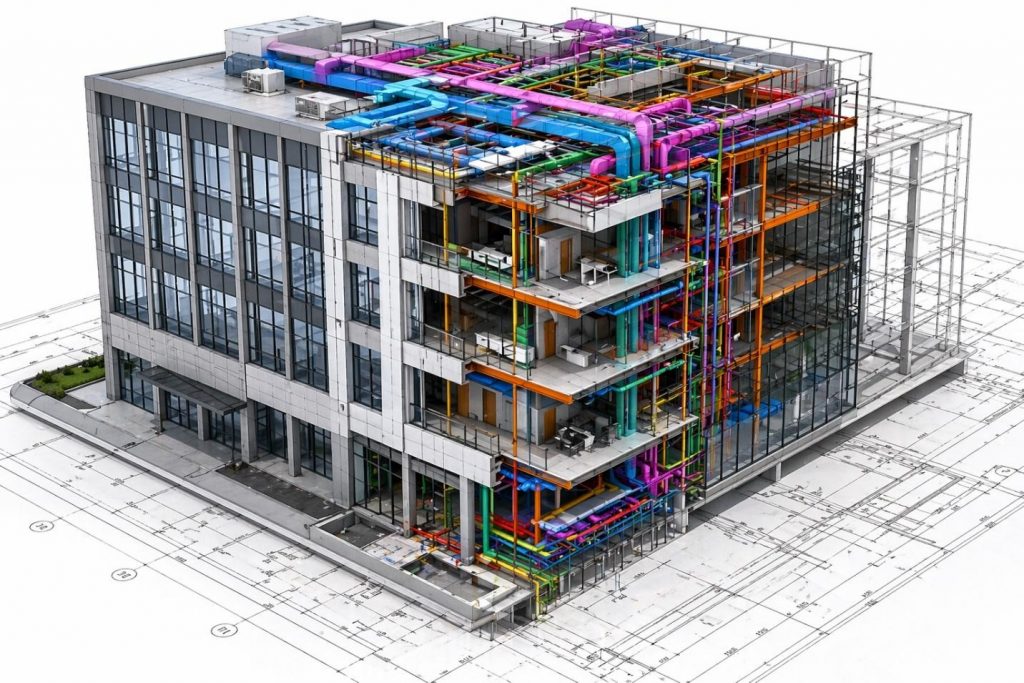
Large scale U.S. developments demand precision at every project phase. Complex projects carry strict federal and state code requirements. Multi stakeholder teams must coordinate thousands of design decisions simultaneously. A single data discrepancy in this environment triggers costly fields corrections. Digital modeling at enterprise scale addresses these coordination demands with measurable accuracy.
The U.S. construction industry has transitioned from isolated design workflows to integrated digital delivery models. Project teams now operate within federated environments where architectural, structural and MEP data merge into one coordinated system. This shift empowers VDC leads and principal architects to detect conflicts early and validate spatial relationships with precision. BIM managers gain full lifecycle visibility from schematic design approvals through final facility handover.
Understanding Core Architectural BIM Services
Enterprise level BIM modeling functions as the single source of truth for every project stakeholder. Highly detailed 3D BIM models carry geometry, material specifications, cost data and scheduling parameters simultaneously. BIM managers access this intelligence across every project phase from conceptual design through construction documentation. This integration replaces fragmented drawing sets with a unified, queryable digital asset that disciplines interrogate in real time.
Core Features at the Enterprise Level:
- LOD 400 Parametric Families: Fabrication grade model components with precise dimensional, material, and assembly parameters, ready for direct field execution.
- Automated QTOs: Real time material calculations extracted directly from model elements, supporting accurate cost forecasting across all project phases.
- Conflict Resolution: Coordinated review sessions in Navisworks Manage that identify and resolve clashes.
- Spatial Validation: Systematic verification of dimensional accuracy, clearances and construction code compliance across all building zones and structural systems.
Highly detailed models produced through Architectural BIM Services directly accelerate construction planning and site logistics decisions. Site teams use federated models to sequence crane placement, material staging, and access routing. Revit worksharing allows distributed project teams in a central model in real time. Industry Foundation Classes exports connect model data to quantity surveying, scheduling, and facility management platforms across the full project ecosystem.
BIM Solutions for Large Scale Project Success
Automated Clash Detection: Automated clash detection identifies spatial conflicts between architectural, structural and MEP elements before field mobilization. BIM managers run interference checks in Navisworks Manage clashes. This process assigns priority levels to each conflict and routes resolution tasks to the responsible discipline. Teams correct design conflicts at documentation stage, eliminating costly rework and protecting the project schedule.
4D Construction Sequence Simulation: 4D sequence simulation links model elements to scheduled project activities, producing a visual construction timeline. VDC leads animate each construction phase to verify sequencing logic, crane reach, and material delivery windows. This simulation readily exposes scheduling conflicts and phasing gaps before ground breaks. Project managers present accurate phase-by-phase visual narratives to clients, aligning all stakeholders on the approved delivery strategy.
LOD 400 Parametric Family Development: Level of Development 400 parametric family development produces fabrication-grade components with precise dimensional, material, and assembly data. BIM teams’ author custom Revit families for structural connections, curtain wall systems and MEP equipment. Each family carries embedded specification parameters feeding directly into QTOs and procurement schedules. This detail level removes interpretation gaps between design intent and field installation, advancing construction accuracy significantly.
Revit Worksharing and Federated Model Management: Revit Worksharing allows multiple discipline teams to coauthor a central model in real time. BIM managers assign worksets by discipline, floor, or system to maintain model performance. Federated model management merges architectural, structural, and MEP models into a single coordinated environment. This workflow accelerates interdisciplinary coordination, reduces file conflicts and maintains an auditable digital record throughout the project lifecycle.
IFC Data Exchange and Interoperability: IFC data exchange transfers model intelligence between Revit, Navisworks and third-party platforms. Open BIM standards allow professionals to access model data in preferred software. BIM managers export IFC files with custom property sets mapped to project specifications. This interoperability framework connects design data to procurement, analysis and operations, forming a continuous, unified digital thread.
Conclusion
Digital precision defines the performance standard for large scale U.S. construction. Federated modeling, parametric design, and open BIM protocols produce measurable gains in coordination efficiency and cost accuracy. Project teams that invest in enterprise grade digital workflows position themselves to deliver complex infrastructure with greater predictability. The U.S. construction sector advances through data intelligence and that advancement begins at the model level.