Real Estate Businesses Embrace Mobile Technology to Improve Property Management
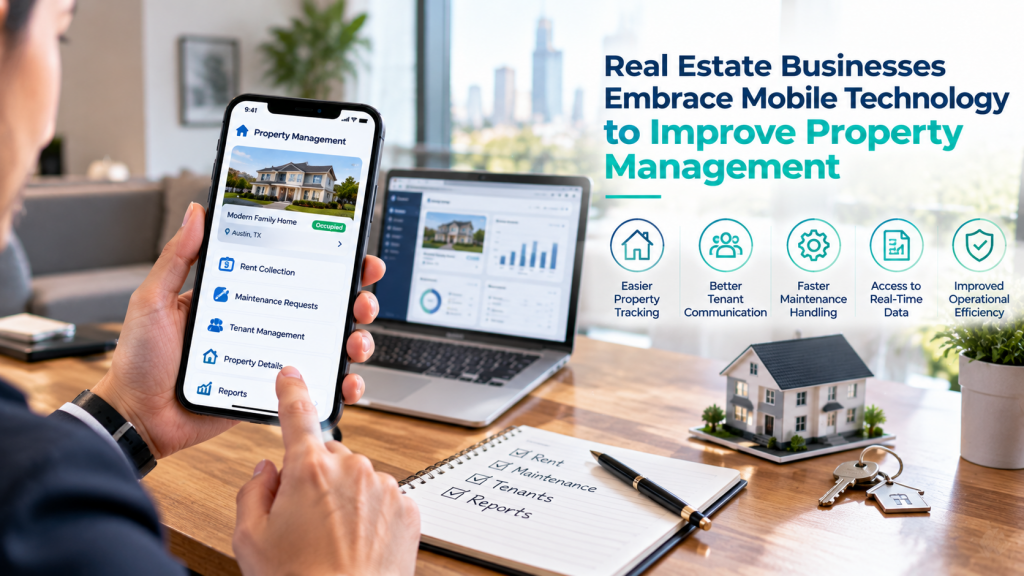
A property manager responsible for a dozen buildings may still learn about a broken elevator from a tenant’s forwarded phone call after the tenant fails to reach anyone else. Meanwhile, maintenance requests accumulate in a shared inbox that no one checks reliably, and rent payments are pieced together from spreadsheets, bank statements, and sticky notes. Businesses that have modernized are moving away from this scattered, reactive way of managing properties, which is why so many real estate companies are turning to an experienced Real Estate App Development company for a more organized and responsive system.
Property management has always depended on a steady stream of small interactions: maintenance requests, rent collection, lease renewals, and communication with tenants. Mobile technology fits this work particularly well because it supports the frequent, detail-heavy coordination those tasks require.
Why Traditional Property Management Struggles to Keep Up
In the conventional method of managing these properties, you’re balancing phone calls, e-mails, paper leases and disconnected spreadsheets for several properties and dozens or even hundreds of tenants all at once. That can be done on a small scale, but things begin to fall apart as the portfolio grows. Maintenance requests go unsent, rent is not tracked on time and tenants may feel that reaching out to their property manager requires more effort than it should.
These issues are not about the day to day. They can have a direct impact on tenant satisfaction and retention. If the property is in a competitive rental market, slow response times and poor communication can make the difference between renting the property and moving to a better managed property in the area.
How Mobile Apps Are Transforming Property Management
1.Submit and track maintenance requests instantly.
Tenants can report maintenance concerns via an app with photos attached instead of on a call that may not be answered, or an e-mail that may not be read. These requests can be tracked, assigned and updated in real time by property managers, ensuring that tenants have visibility of progress and not wait to find out if their request was even received.
2. Ease the collection and tracking of rents.
Mobile applications have revolutionized the way rent is collected, enabling tenants to pay directly via the app and for property managers to receive rent automatically and be reminded of any late or upcoming payments. This helps to save administrative effort in reconciling payments between various properties and payment channels.
3.Centralized communication of tenants with management.
Instead of random telephone calls and emails, the app offers a unified communication line between tenants and property management, all of which is tracked. This helps eliminate miscommunication that can occur when crucial information is missed across numerous, disjointed communication channels.
4. Digital Lease Management and Document Access
Having all of the leases, renewal notices, and other important documents in an app means that property managers and tenants both have immediate access to any documents they need; no digging through filing cabinets or sifting through months of emails trying to locate a particular attachment.
5. Real-Time Property and Portfolio Visibility.
Apps that bring all the data together for all of the buildings within a property management portfolio offer the ability to see occupancy levels, maintenance backlogs and the financial performance of all assets on a single screen at any given time, which means they can make decisions significantly faster and more thoroughly than a spreadsheet ever could.
6.Automated Reminders and Notifications
App notifications can send reminders for lease renewal dates, scheduled maintenance, and inspection dates, among other things, ensuring that critical dates don’t fall through the cracks when a property manager has too many things on their plate.
7. Simplified Tenant Screening and Onboarding
Similar to the way that searching for a home online has made moving into a new home less of a chore, many property management software packages also offer ways to screen prospective tenants and handle the moving of a new tenant electronically, eliminating the additional paperwork and time it used to take.
The Business Impact of Better Property Management Technology
Stronger Tenant Retention
Tenants who experience quick, responsive communication and efficient maintenance handling are considerably more likely to renew their leases. In a market where finding new tenants costs both time and money, this retention advantage translates directly into stronger financial performance for property owners and managers.
Reduced Administrative Overhead
Automating rent collection, maintenance tracking, and communication frees property management staff from repetitive manual tasks, allowing them to focus on higher-value work like tenant relationships and strategic portfolio decisions rather than administrative firefighting.
Better Financial Oversight
Real-time visibility into rent collection, maintenance costs, and occupancy trends allows property owners and managers to make faster, more accurate financial decisions, rather than relying on delayed or incomplete manual reporting that often obscures the real picture until it’s too late to act on it effectively.
Fewer Costly Maintenance Delays
Faster maintenance request tracking means issues get addressed before they escalate into bigger, more expensive problems. A leak reported and fixed quickly costs far less than one left unaddressed for weeks because the original request got lost in an overloaded inbox.
Choosing the Right Development Partner
As this technology has become central to modern property management, the choice of partner for building or implementing it deserves careful attention. Before making a commitment, businesses often compare several Top mobile app development companies, focusing on experience with property management workflows, the ability to integrate with existing accounting or CRM systems, and a real grasp of the day-to-day challenges property managers face.
The right partner first learns how large the portfolio is, who the tenants are, and where daily operations are falling short. A generic solution may function on paper, but it can miss the way a particular business actually works.
What Sets Successful Property Management Apps Apart
Not every property management app delivers meaningful results simply by existing. The ones that genuinely improve operations tend to share specific traits: they’re intuitive enough that tenants actually use them without frustration, they integrate smoothly with existing financial and administrative systems, and they provide real-time data that property managers can actually act on rather than static reports that arrive too late to be useful.
Looking Ahead
As property management technology continues to mature, expect deeper integration with smart building systems, more sophisticated predictive maintenance capabilities that flag potential issues before they become costly repairs, and continued expansion of self-service features that let tenants handle more of their own account management directly through the app.
Final Thoughts
Property management has long relied on owners, managers, and tenants coordinating over a steady stream of details. Mobile technology has made that work faster and clearer, while reducing the breakdowns common in traditional manual processes.
The real estate companies managing their properties best today do not necessarily have the largest portfolios. More often, they are the ones that invested in mobile technology designed around the daily demands of property management instead of relying on a patchwork of tools that were never built for that work.