What Real Estate Professionals Look for in Sustainable Markets
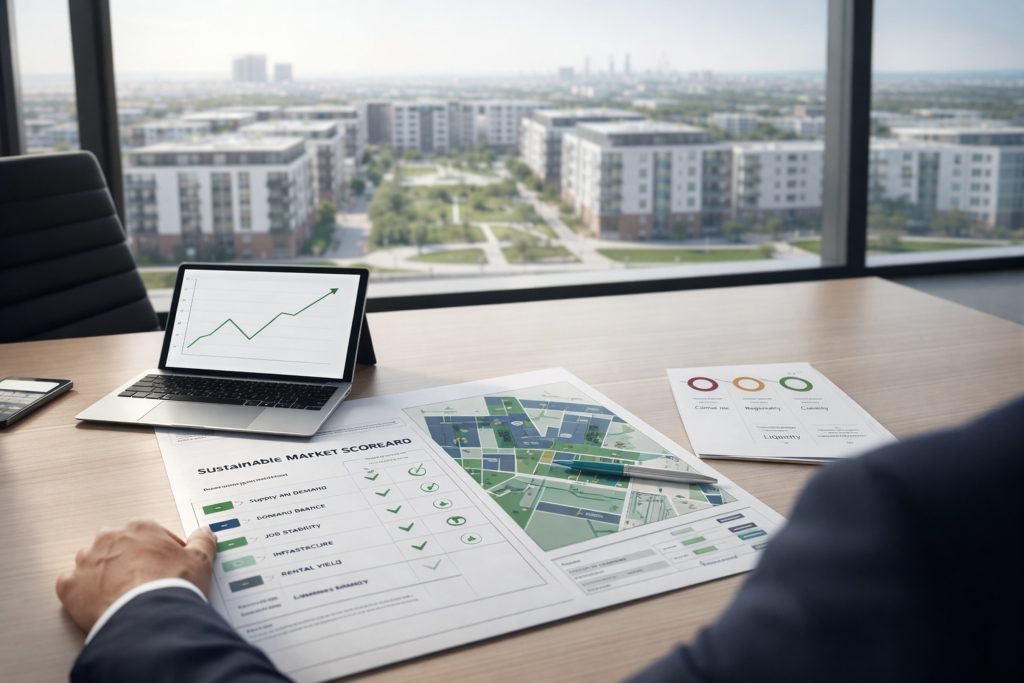
Property experts stay away from “trendy” neighbourhoods that don’t last long. Instead, they put their money into stable real estate sectors that will keep their value no matter what the economy is like. The goal is to make things work better over time, cut down on problems that come up out of the blue, and make it easy to sell or refinance when you need to.
This guide tells you how experts find stable markets, how they tell the difference between real growth and just excitement, and how you can use that information when you buy property or manage your portfolio over time.
What “Sustainable Market” Means for the Real Estate Market
When experts talk about strong real estate sectors, they mean more than just buildings that use less energy. They are talking about a place that can last and grow because there is real demand, a good quality of life, good systems in place, and careful management of any problems that may come up.
When trying to figure out what makes a property market sustainable, experts look at the big picture. This includes things like how many jobs are available, how many construction projects are already planned, the rules for loans, how people behave in the area, and how the area handles compliance and environmental issues. These things about strong property areas help keep prices from going up or down too quickly when things change.
You can tell if a property market is strong by seeing if you can still make a good return even if prices go down. This is because the main factors (rental incomes, vacancy rates, location desirability, and liquidity) stay the same. This way of thinking is very important for buying real estate and building up a steady collection of assets.
Why Real Estate Agents Put Markets That Last First
Experts say that real estate markets that are strong are better because they last longer. It keeps your money safe, smooths out your income, and lowers the chance that you’ll get stuck in a slump with few buyers.
This makes it clear why environmental factors are important when buying property: they lower risk by making the property more likely to last. The best ways to invest in property that will last don’t depend on knowing when to buy. Instead, they look for places where there are a lot of different kinds of buyers and where problems can be fixed. That makes it possible for real estate to do well for a long time.
When experts look at strong property markets, they ask the same questions over and over:
- If travel goes down, does the need for local services stay the same?
- If money gets tight, do the people who want to buy something go away or change?
- Can the area handle the extra supply if more units become available?
Important Signs of a Good Real Estate Market
In stable areas, strong signs of a healthy property market appear consistently over time. Experts look for trends in data that indicate the market is doing well, even if the specific details change.
Key factors that indicate a strong property market include:
- 1. Balancing supply and demand: Buyers and renters can’t take on more than what new buildings offer.
- 2. Attracting buyers: Don’t depend on a single major employer, a temporary trend, or just one group of customers.
- 3. Good cash flow: When cash flow is strong, real estate deals can go through quickly and without significant price drops.
- 4. Necessary infrastructure: Utilities, transportation, internet access, and local amenities support people living and working in the area long-term.
- 5. Better construction quality: Use durable materials, build them well, and apply professional property management practices.
Experts also look at how property values are changing over time, which can affect how desirable it will be in the future. For example, they look at things like being able to provide their own power, saving water, and planning for the future of the community. These kinds of changes in resilient markets are getting more attention from experts because they affect costs of coverage, maintenance, tenant needs, and future valuation stories.
Experts Keep a Close Eye on What the Market Is Saying.
Even when the basic numbers are good, experienced professionals keep an eye on the “feeling” of the market because buyer attitudes can change from steady growth to weakness. These tests tell us if the real estate market is stable or if it is just going up for a short time.
Important signs of how the market is changing:
- Value goes up when compared to money made from leases: When asset prices go up much faster than lease rates, durability goes down.
- All of the properties stay on the market for the same amount of time: Steady Places don’t need a quick burst of excitement.
- Changes in the way prices move: A lot of the time, listings that need big price cuts show that the market isn’t as strong as it seems.
- The buyers: A lot of dependence on investors who want to make quick money is a sign of possible danger.
- The status of the construction that is coming up is: Experts need to know about planned building schedules because even strong markets can become unstable when supply suddenly rises.
This is when skill becomes very important. Adepts look for normal negotiations and lender reviews that are expected, not a case where “every asset moves right away, without question.” When those warnings show up, it’s harder to say that you’re in a good area for development.
Looking at the Real Estate Market Using ESG Factors
ESG (Environmental, Social, Governance) is now a real way to look at strong real estate sectors, not just for getting the word out. Experts use ESG to guess what investors want, what the costs of doing business will be in the future, and what regulatory issues will come up.
Things that have an impact on the environment
The long-term health of a property market depends on how well it can handle climate change and how many resources it has:
How much maintenance is needed and how much insurance costs depend on things like heat waves, floods, bad weather, and access to water.
The dependability of power sources affects how happy tenants are, how much it costs to run the property, and how much rent it brings in.
The design details of the site, such as drainage, solar shielding, windproofing, and the direction of the building, determine how long assets will last.
Social Factors
Professionals look for signs of a good quality of life in the area and that amenities are easy to get to. These are things that help keep property values high. There is usually more demand for places that people want to live in all year round.
Open Management
Having clear rules and a way to guess how they will be used is very important. Simple zoning and clear approval processes help people avoid problems that come up out of the blue and improve their ability to see things coming, both of which are important for finding resilient property areas.
These ESG parts go well with how people think about taking care of their property these days. More and more people who want to buy or rent homes are looking for ones that are strong, built to high standards, and have well-planned neighbourhoods.
Sustainable Markets vs. Speculative Markets
Experts can tell the difference between strong property sectors and those based on speculation because the way they work, how they get money, and how they plan to sell the property are all very different.
Prices in a healthy market depend on things like regional income, how useful something will be in the long run, and well-thought-out rental yield estimates.
- Real absorption is the same as new construction.
- There are many places where interest comes from.
In a speculative market, the worth of something depends on how the market is doing now and how much money it is expected to make in the future.
- Buyers care more about making quick sales than getting long-term value.
- Availability is often more than what the end user really needs.
One of the easiest ways to find strong property markets is to ask yourself, “Would this still be a good buy if I had to keep it longer than I planned?” That question is what experienced real estate agents look for in sectors that will last; they think about how the timeline might change.
This difference also shows how important it is for real estate to last. With solid sectors, you have more choices. You can keep, rent out, look for new loans, or sell without having to wait for the right conditions.
How Being Environmentally Friendly Helps Long-Term Investments Do Better
Making sudden choices more specific makes it more likely that you will succeed in the long run. In stable real estate markets, people with money have to deal with fewer unexpected events that make them sell at bad times or spend money they didn’t plan to.
When looking for strong property holdings, experts usually look for:
- More reliable levels of tenants and demand
- Not as big a difference in how easy it is to sell
- More closely related to changes in tastes and movements for building green
- There is too much supply, so the chances of losses are lower.
This is why experienced people are careful when looking at strong real estate markets. They would rather get steady returns than take a chance on big price rises. As time goes on, steadiness gets stronger, especially when places stay interesting by making their facilities better and redesigning their towns.
You can get a better idea of what “market suitability” looks like in current listings by looking at the available stock on Samana Real Estate.
Things People Do Wrong When They Look at “Sustainable” Markets
A lot of investors say they want to put money into real estate sectors that are good for the environment, but they use bad rules to do it. Professionals stay away from these traps because they know that a “good story” can quickly lose its appeal.
Mistakes that happen a lot:
- Mixing up green buildings with a stable market: A few well-built buildings don’t show what makes a property sector last for a long time.
- Ignoring the development pipeline: A strong need can even make the market full.
- Putting too much stock in short-term rental trends: It can be less stable to depend on changes in the seasons and booking sites.
- Putting price hikes and strength on the same level: Just because something’s value goes up doesn’t mean it will last.
- Not paying attention to regulatory evaluations: Unclear rules make it harder to trade assets and cause costs that weren’t expected.
Make your ownership plan first. That’s a smart move. You need stable property environments that work well with cautious projections if you want to make a big commitment.
What Experts Think About Local Sustainability
Experts agree that sustainable real estate works best on a small community and block scale, even though a lot of research is helpful. Ground-level facts check whether a sector’s claims about sustainability are true for a specific holding.
Here are some common ways that experts localize:
- 1. Community appeal: Learn about the residents and what attracts them to the area.
- 2. Functional reachability: Check how easily people can access places for daily tasks, not just for leisure.
- 3. Confirm the real estate function: Ensure that building maintenance, staffing, and supplier support match the property’s needs.
- 4. Factors that affect how long a building lasts: These factors can improve a property’s value in a strong market and make it cheaper to maintain over time.
- 5. Selling options: Learn how easy it is to sell the property to different types of buyers.
When considering a purchase in a new area, engage with individuals who are familiar with local listings and understand what buyers are seeking.
Conclusion
Experienced real estate brokers excel at identifying promising neighborhoods that are likely to thrive, even in challenging economic climates. They meticulously track builders to ensure projects are completed on schedule and within budget. Investors take multiple factors into account when evaluating properties, such as neighborhood quality, home conditions, and demographic shifts, with a strong focus on Environmental, Social, and Governance (ESG) criteria. This helps them align investments with long-term goals and assess community impact.
To discover investment opportunities while minimizing risks, agents scrutinize market demand, property prices, construction timelines, and project management strategies. Relying on flashy advertisements alone fails to capture the complexities of a robust real estate market; data-backed trends offer much clearer insights. Experienced professionals utilize their research and practical knowledge to navigate and resolve challenges effectively.
Questions and Answers
What does it take for a property market to be truly sustainable?
It needs a balance between supply and demand, real appeal to real people, and exposure that can be controlled over time. Analysts want to see long-term ease of exchange, not just short-term price jumps.
Do markets that are good for the environment usually make more money over time?
A lot. Lease income and buyer interest tend to stay more stable, which means that forced sales are less likely to happen. There are no guarantees that the results will be good, but being sustainable usually leads to better performance.
How do professionals determine if real estate is sustainable?
They look at the main things that affect demand, like expected sales volume and inventory, as well as risk assessments that are unique to each area. They prefer steady signs to short-term market excitement.
If a sector has high-quality “eco” construction, is that enough to call it “sustainable”?
Not entirely. It’s good to build in a way that is good for the environment, but the market won’t work well unless there is long-term oversight, steady demand, and careful growth.
How does being sensitive to the weather affect the strength of the property market?
Risks related to the weather make running a business more expensive, make it harder to get insurance, and slow down market activity, all of which are bad for long-term stability. You need to know how to deal with climate exposure in order to make smart investment choices.