The Digital Construction Revolution Starts with CAD to BIM
Something changed in construction over the past five years. The 2D drafting workflow that defined the trade for three decades now plays a supporting role. Data-rich 3D models hold the lead. Architects, engineers, and contractors expect every digital part to carry real intelligence inside it. A wall is more than four lines on paper. Today, that same wall stores its fire rating, U-value, manufacturer, install date, and replacement cost.
A subway expansion in Chicago packs thousands of interconnected systems into one volume. Hospitals run even more densely. Precise digital capture holds coordination together across every discipline. Parametric modeling provides returns throughout the entire asset lifecycle, from groundbreaking to tenant fit-out. Firms from California to New York treat this shift as table stakes for winning major contracts.
What is CAD to BIM in Digital Construction?
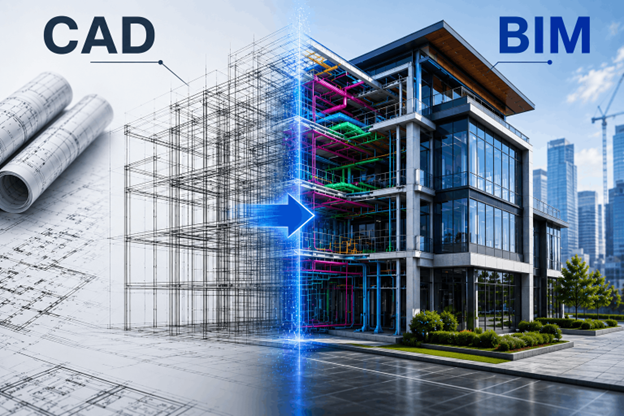
The shift converts static vector geometry into intelligent object models loaded with data. Computer-aided design draws clean 2D plans and rough 3D shapes for sections, elevations, and details. Building Information Modeling pushes deeper. Each beam, wall, duct, and door holds embedded data on size, material, vendor, cost, and service life. A 14-inch concrete beam tagged with rebar density and mix specs replaces a flat rectangle on a printout. Parametric objects react instantly when designers shift any related geometry.
The transition gives the project a Single Source of Truth across its full lifecycle. Architects, engineers, contractors, and facility operators tap the same authoritative dataset. Federated models pull architectural, structural, and MEP work together inside a Common Data Environment. Through IFC formats, project teams pull components in and out of any OpenBIM-friendly platform. The market has answered with CAD to BIM Modeling Services that hit LOD 300-400 and embed COBie data for handover. Each parametric element carries attributes for downstream asset management decades after construction wraps. Cloud platforms host these federated models for live coordination across teams scattered around the country.
How CAD to BIM Solves Modern Construction Challenges
Digital coordination pulls construction from manual paper checks toward live model validation. Teams run clash detection routines that catch geometric conflicts inside the federated container. Algorithms scan every dataset and flag interferences across architectural, structural, and MEP layers in seconds. One software pass replaces days of manual sheet review across plotted drawings. The model itself takes the role of audit instrument for accuracy and constructability.
Challenge 1: Fragmentation of Design Data
Old drafting scatters project information across DWG, PDF, and spreadsheet files spread through email chains. Each discipline keeps its own dataset. Those files drift apart through every revision cycle. Parametric BIM environments pull the data back together through interoperable IFC formats. Open standards from buildingSMART support clean handoffs across Revit, ArchiCAD, Tekla and Bentley platforms. Traditional CAD drawings feeds straight into the BIM workspace using automated translation platforms. Years of legacy DWG drawings find a second life inside the parametric environment. Federated models merge architectural plans, structural frames, MEP routes, and civil geometry into one container. The CDE gives every stakeholder live access to the latest version at any hour of any day.
Challenge 2: Inaccurate Material Quantization
Every wall, slab, beam, conduit, and fixture in the parametric model carries its quantity attributes. A single command pulls the full take-off out of the BIM platform. Estimators read concrete volumes, steel tonnage, drywall square footage, and ductwork lengths straight from the live data. The CAD era used slow manual measurement of static drawings. Counting errors slipped into every revision. Material quantities now sync the moment a designer moves a wall. Procurement now writes orders against the model’s verified counts. Padding falls away. Waste drops on every order. Budgets land closer to the original capital plan from week one.
Challenge 3: Spatial Interference and Coordination
An HVAC duct routes through a structural beam. A sprinkler line crosses an electrical tray. These collisions hit the field crew during install and trigger expensive rework. BIM platforms run automatic clash detection across the federated model at LOD 300-400 maturity. Coordination engineers fire up Navisworks or Solibri against pre-set geometric tolerance rules. Hard clashes, soft clashes, and workflow clashes land inside a shared issue tracker for resolution. Each conflict gets a responsible party, a target resolution date, and a status flag. Teams settle geometric issues inside the virtual model long before any crew shows up on site. Rework drops sharply, schedules hold firm, and safety incidents fall across active projects.
Why Businesses Are Investing in BIM Today
Owners and developers pull direct financial returns from virtual pre-construction work. Early clash resolution inside the model kills the RFIs that would otherwise inflate the budget. McKinsey Global Institute found large construction projects run 20% over schedule and 80% over budget on average (source: McKinsey, Reinventing Construction, 2017). Risk mitigation starts at the design table rather than the job site. Quantity gaps, code violations, and constructability flaws turn up during the virtual coordination phase. A digital fix costs a fraction of an equivalent site fix. Capital exposure shrinks, contingency reserves stretch further, and delivery dates hold.
In the U.S. market, transparent data delivery now decides who wins the major contracts. Public agencies and Fortune 500 owners want federated models with COBie attributes baked in. The General Services Administration asks for BIM submissions on major federal building projects. A bidder walking in with LOD 300-400 deliverables usually walks out with the contract. Clients trust cost forecasts pulled directly from the live model. Lifecycle data inside the BIM file supports facility management decades past handover. Digital transparency now sits at the center of trust across the U.S. construction market.
Future Trends in CAD to BIM Transformation
AI tools now reshape the digital construction pipeline in real ways. A point cloud arrives from a LiDAR sweep. Machine learning engines turn that raw geometry into parametric BIM elements within hours. Algorithms classify columns, beams, ducts, and pipes with growing precision. Real-time cloud collaboration platforms host federated models for distributed engineering teams. An engineer in New York coordinates with a fabricator in Texas inside the same live environment. Generative design tools spin up dozens of alternatives tuned for cost, carbon, and structural performance. Digital twin integration pushes the BIM model into operational service after the building opens. The next decade will redefine AEC through intelligent automation and connected data ecosystems.
Conclusion
Digital precision tracks closely with long-term asset performance across every building class. Parametric models give owners a living record of their facilities for decades of service. The path from CAD to BIM takes investment, training, and patience. Firms walking that path today gain real ground in cost control, schedule predictability, and lifecycle outcomes. Data-rich modeling now forms the foundation of future AEC success across the United States.