Revitalizing Old Structures Through Adaptive Reuse
Introduction
Old factories, warehouses, churches, and colonial-era structures that have outlived their original purposes can be found in cities all over the world. Many of these buildings become neglected and remain silent monuments of the past as industry and urban habits change. Although demolishing
them can seem like the simplest answer, doing so frequently results in considerable environmental waste and the loss of cultural value.
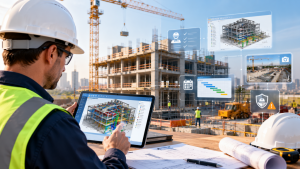
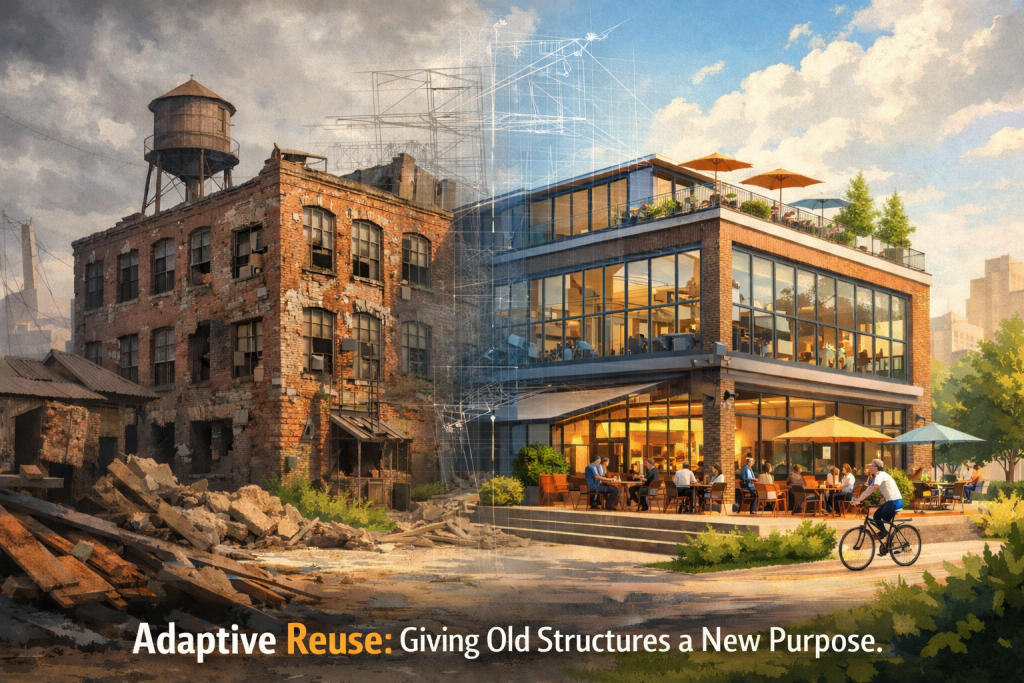
Adaptive reuse is useful in this situation. The technique of giving historic structures new uses while preserving their historic characteristics is known as adaptive reuse. BIM services play an important role in such projects by enabling accurate documentation, digital modeling, and analysis of existing structures such as old factories, warehouses, churches, and colonial-era buildings. In addition to conserving history, adaptive reuse fosters sustainability, innovation, and economic growth. Examples of this include converting warehouses into offices, railroad stations into cultural centers, and industries into loft apartments.
This blog explores the concept of adaptive reuse, its benefits, global examples, challenges, and its growing relevance in today’s world.
The Concept of Adaptive Reuse
The goal of adaptive reuse is to preserve the historical and architectural relevance of existing places while converting them into contemporary, useful amenities. It goes beyond simple renovation.
Adaptive reuse focuses on giving a structure a new life and purpose that meets modern needs, as opposed to restoration, which aims to return a property to its original state.
An ancient textile mill, for example, might no longer be used for industrial reasons, but with careful planning, it could be transformed into a residential complex or co-working space. Adaptive reuse is based on the idea of “conservation through transformation.”
Benefits of Adaptive Reuse
1. Preserving Cultural Heritage
Every historic building has a backstory. Whether they are a factory from the industrial age, a medieval cathedral, or a colonial courtroom, these structures capture the character and
development of a community. Instead of being destroyed by bulldozers, adaptive reuse makes sure that these cultural landmarks stay a part of contemporary cities.
2. Environmental Sustainability
One of the biggest causes of carbon emissions worldwide is construction. Massive volumes of garbage and energy are produced during building deconstruction and new construction. Adaptive reuse lowers the carbon footprint, saves waste, and lessens the need for new resources. When compared to new construction, repurposing buildings can reduce carbon emissions by as much as 50%, according to the National Trust for Historic Preservation (USA).
3. Economic Revitalization
Old buildings can be revitalized to boost local economies. Converted buildings revitalize neglected neighborhoods by drawing in people, businesses, and tourists. For instance, converting factories into commercial and cultural venues has revitalized numerous deteriorating industrial neighborhoods in the US and Europe.
4. Creative Design Opportunities
Adaptive reuse is seen by designers and architects as both a difficulty and an opportunity. It calls for striking a balance between contemporary practicality and vintage appeal. The ultimate effect is frequently distinctive areas that successfully combine modern design with historical elements, something that is rarely accomplished by entirely new construction.
Global Examples of Adaptive Reuse
1. Tate Modern, London
Originally a power plant, the Tate Modern is now one of the top galleries for modern art worldwide. Modern exhibition areas were added while maintaining a large portion of the building’s original industrial character.
2. High Line, New York City
An abandoned elevated railroad line, known as the High Line, was turned into a public park. Today, it is a well-known example of urban adaptive reuse, drawing millions of tourists each year and promoting local development.
3. Zeitz MOCAA, Cape Town
Grain silos used to be the Zeitz Museum of Contemporary Art Africa. As the biggest museum of
contemporary art in Africa today, it serves as an example of how adaptive reuse can support culture and preserve legacy.
4. India’s Haveli Hotels
Numerous historic havelis, or ancient houses, in Gujarat and Rajasthan, India, had been transformed into boutique hotels. This promotes tourists and local jobs in addition to protecting architectural history.
Challenges in Adaptive Reuse
Structural Limitations: Older structures could need major retrofitting because they don’t satisfy modern safety standards or because they’ve deteriorated significantly.
High Initial Costs: The initial cost of specialist design and restoration may be greater than that of new building, even if adaptive reuse might result in long-term cost savings.
Regulatory Barriers: Adaptive reuse projects may be complicated by zoning restrictions, building codes, and historic preservation legislation.
Balancing Old and New: It’s a delicate task that calls for tact and talent to maintain authenticity while adding contemporary conveniences.
Adaptive Reuse in the Context of Sustainability
The significance of adaptive reuse has increased due to the urgency of climate change. The building sector needs to change its emphasis from new construction and demolition to recycling existing resources as cities work to become greener. Adaptive reuse extends the lifespan of ancient
structures, which is in line with the circular economy’s tenets of continuously reusing resources and
materials rather than throwing them away.
Adaptive reuse also promotes resilience and communal identity. Even as their towns modernize, inhabitants feel a feeling of continuity and belonging when familiar landmarks are preserved in changing urban landscapes.
Conclusion
Adaptive reuse is a concept that honors the past while creating for the future, not only a design approach. Giving historic buildings new uses helps us advance sustainability and economic prosperity while also preserving cultural identity.
Adaptive reuse provides an innovative, conscientious, and significant response to the urgent
problems of resource shortage, urbanization, and climate change. Future cities will be evaluated on how successfully they incorporate their historical heritage in addition to their modern towers.
The enormous potential of adaptive reuse is demonstrated by the conversion of abandoned
factories into thriving cultural centers, old residences into boutique hotels, and abandoned railroads into green spaces. How rapidly we can make it a key component of urban development policies around the world is the question, not if we should accept it.
In many adaptive reuse projects, BIM services, including Scan to BIM, point cloud to BIM modeling, and as-built BIM documentation, support architects and engineers in accurately understanding existing structures and planning efficient renovation and restoration strategies.