From Listings to Leads : How Staff-as-a-Service Supports Modern Real Estate Teams
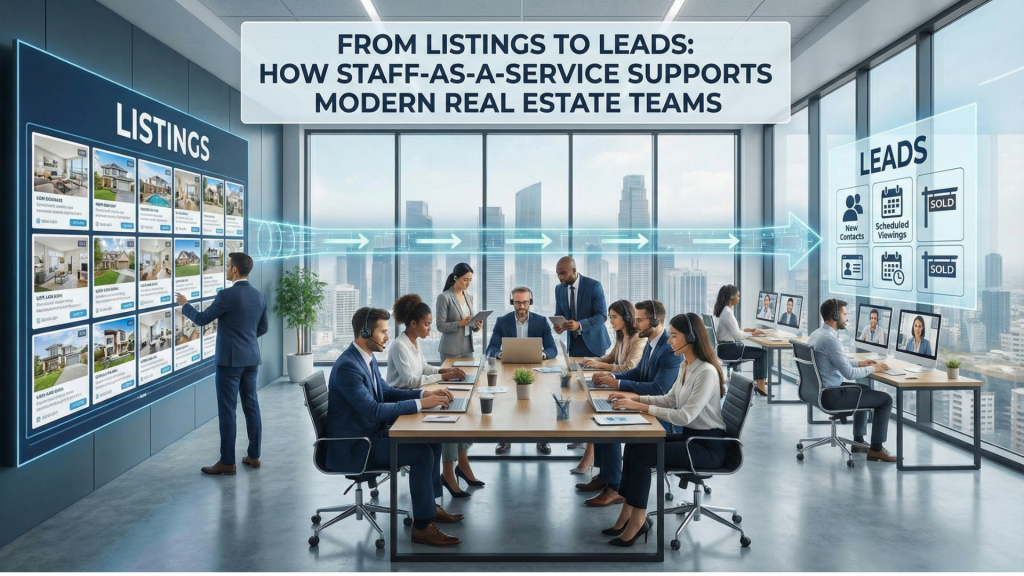
In an era defined by rapid market shifts and fluctuating interest rates, the traditional blueprint for building a real estate team is undergoing a fundamental transformation. For high-growth firms, the challenge is no longer just about finding talent – it is about maintaining organizational agility without compromising service quality.
This is where Staff-as-a-Service for real estate has moved from a niche alternative to a primary strategic lever. By decoupling operational capacity from fixed overhead, modern firms are finding they can move faster, leaner, and with greater precision.
The Shift Toward “Elastic” Operations
The industry used to function in two ways: either hiring a full-time staff member or assigning work to a general virtual assistant. Both models have trouble handling the intricacies of intricate brokerage operations or high-stakes property management.
Modern real estate staffing solutions have bridged this gap. Instead of a rigid headcount, firms now leverage an “elastic” workforce – a model that allows forreal estate team scaling in real-time. Whether a firm is managing a sudden influx of seasonal listings or expanding into a new asset class, the ability to activate specialized professionals on demand ensures that growth is never stifled by administrative bottlenecks.
Enhancing Core Focus Through Specialization
The most successful organizations recognize that their internal “A-Team” should be reserved for high-value, revenue-generating activities: negotiation, relationship building, and strategic acquisitions.
Whereas on-demand staff for real estate teamscan take over the essential, yet time-intensive, technical functions, including:
- Transaction Coordination
Managing the intricate paperwork trail from contract to close with military precision. - Market Intelligence & Data Entry
Populating systems with accurate, up-to-date property data to drive informed decision-making. - CRM and Lead Management
Ensuring no inquiry goes cold while the primary team is in the field.
By offloading these functions to a dedicated service model, the internal leadership can focus on the “why” and “how” of the business, rather than the “where” of the paperwork.
Financial Efficiency as a Strategic Advantage
From a fiscal perspective, the Staff-as-a-Service model shifts the cost structure from a fixed liability to a variable operational expense. This transition is particularly valuable for senior-level oversight.
| Feature | Traditional Model | Staff-as-a-Service Model |
| Overhead | High (Benefits, Office Space, Tech) | Minimal (Subscription-based) |
| Training Time | Weeks to Months | Immediate (pre-vetted expertise) |
| Scalability | Slow (Recruitment cycles) | Rapid (On-demand activation) |
| Market Risk | Fixed costs persist during market contractions | Costs align with current volume |
This financial fluidity allows firms to protect their margins during market corrections while remaining ready to strike when opportunities arise. It removes the “hiring lag” – the period where a team is overworked because they aren’t quite ready for a new full-time hire but are clearly beyond their current capacity.
Integrating Expertise, Not Just Manpower
One of the most significant misconceptions is that Staff-as-a-Service for businesses is merely about “extra hands.” In reality, it is about access to expertise. Modern flexible staffing partners specialize specifically in the real estate industry. This means the individuals being integrated into your workflow already speak the language of escrow, cap rates, and compliance. They don’t require an education in the industry – they require only a briefing on your specific firm’s culture and goals.
This capability ensures that the quality of the client experience remains seamless. To the outside world, the team appears as a cohesive, high-performance unit. Internally, it operates with the efficiency of a well-oiled machine.
Conclusion
As we look toward the future of the industry, the firms that thrive will be those that prioritize flexibility. The goal is to build an organization that is “right-sized” at all times – neither bloated during slow periods nor overwhelmed during peaks.
Leveraging Staff-as-a-Service for real estate firms is more than a cost-cutting measure – it is a commitment to excellence and a strategic move to future-proof operations. By focusing on talent over headcount and implementing flexible staffing solutions real estate leaders can build a legacy of efficiency and sustainable growth.
Ready for expansion without increasing fixed overhead? Partner with us to implement a flexible staffing model tailored to your business objectives.